October 08, 2026


Most people first meet poetry at school, where it arrives with a marking scheme attached and a teacher asking what the poet really meant. That is a shame, because poetry began as something friendlier: a way of saying a thing so that it stays said. You do not need a degree, a special vocabulary or a lonely garret to write a poem. You need a subject you actually care about, a notebook, and a few simple forms to practise until the shapes feel natural in your hands.
What follows covers rhyme, metre, line breaks and free verse, then offers exercises you can use to produce a first draft this evening. Treat all of it as scaffolding: useful while you climb, easy to take down later.
Rhyme has a poor reputation because it is so often done badly. Done well, it does two jobs at once. It makes a line memorable, and it creates a small feeling of arrival when the matching sound lands. That satisfying click is why nursery rhymes survive centuries of repetition.
Begin with the forms you already know by heart.
One rule matters more than the rest: never bend your meaning to reach a rhyme. If you need above to finish a line about your grandmother's kitchen and nothing in the scene is above anything, rewrite the line. Rhyme serves the poem. The poem does not serve the rhyme.
Metre is the pattern of stressed and unstressed syllables. Say toDAY aloud and you will hear the second syllable take the weight. English falls naturally into that da-DUM rhythm, which is why iambic pentameter — five of those beats to a line — has carried so much English verse.
Try this line: "I walked the lane and watched the evening fall." Tap the table on each stress: walked, lane, watched, eve, fall. Five taps. Read it again and notice how the line seems to move forward under its own steam.
You do not need strict metre to benefit from it. Counting beats teaches you to hear your own lines, and hearing is the real skill. Read everything aloud. When a line trips you up, the cause is usually one syllable too many or a stress in the wrong place. Cut a word and listen again.
Line breaks are the one tool poets have that prose writers do not, and beginners underuse them. Where a line ends decides what the reader hears last, and for how long.
A line finishing with a full stop is end-stopped. A line running on into the next is enjambed. Both are useful: end-stopping gives a firm, declarative feel, while enjambment creates momentum and suspense.
She packed the boxes one by one, then
Breaking there leaves then hanging at the end of the line, and the reader's eye is already travelling towards the consequence. Break after one instead and the pause lands on the packing itself, which is slower and sadder. Same words, different poem.
Try this with your own draft. Take one sentence and write it out with the break in three different places. Read each version aloud. You will hear which one knows where to stop.
Free verse has no fixed rhyme or metre, which is not the same as having no shape. It borrows other devices: repetition, deliberate pauses, short lines for emphasis, long lines for a rush of thought, and the sounds of words placed close together.
If you write free verse, the line break becomes your entire rhythmic toolkit, so spend your energy there. Read each line alone and ask what it sounds like by itself. Then read the whole poem to check the rhythm of the sentences running underneath the lines.
A common beginner habit is to write a paragraph and then chop it into lines with a knife. That reads as prose with holes in it. Compose line by line instead, deciding as you go which words deserve to end a line and which should run past it.
Leave the poem overnight. In the morning, read it aloud standing up, pen in hand. Cut anything you added purely to sound poetic — ethereal, soul, shadows that dance. Poems usually get stronger when the language gets plainer and the feeling gets bigger. Read it to one person you trust and listen for where they pause. Then write another one, because the second poem is always easier than the first.
Photo: mylns65hoasphn / Pixabay
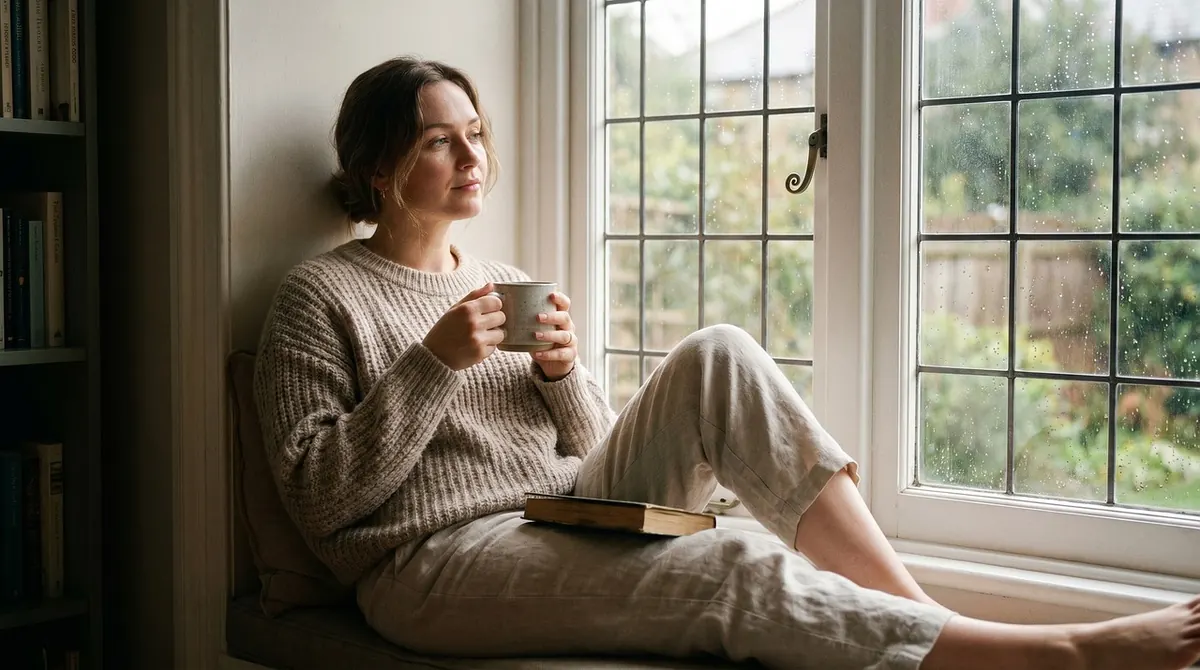
A cozy nest for stories and imagination..
Copyright © 2026 Tale Nest. All rights reserved. Tale Nest.